
Technological innovation
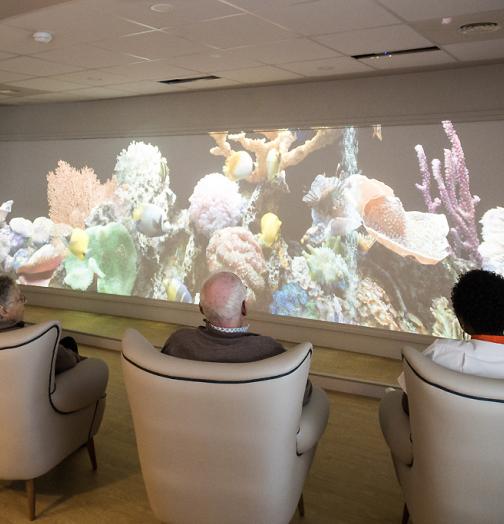
Combining the best in technology, digital technology and artificial intelligence, whether from the market or developed in-house, with our healthcare expertise – this is the spirit that has driven Clariane for several years. It adopts a human approach to technology to leverage innovation with the aim of improving the comfort of patients, residents and caregivers and the safety of all.
Technological innovation at Clariane aims to provide innovative technological solutions to the Group’s key social, societal, and environmental challenges. It responds to four major challenges: continuously improving the well-being, autonomy and comfort of residents and patients, optimising quality of life at work for care staff, and controlling its environmental impact to promote more sustainable practices.
Our European societies are facing considerable demographic changes. By the end of the decade, the population aged 65 and over will have reached 126 million. Digital innovation will be crucial to deliver high-quality services in terms of comfort and safety.

In practice: our examples of technological innovation projects
Koala: technology supporting our teams in their day-to-day work
Developed by Clariane with and for our employees, Koala was designed to meet a simple need: to make everyday work easier for professionals in our facilities and enable them to spend more time on care and support.
A fully integrated digital ecosystem available on a dedicated smartphone, Koala brings together a wide range of features used by teams every day, including phone calls, care documentation, handovers, maintenance requests, information sharing and the monitoring of cleaning and hygiene operations.
Koala continues to evolve in line with the needs of our teams. Now enhanced with an AI-powered voice assistant, it enables care professionals to record certain care-related information simply by speaking, rather than entering it manually. They can, for example, record a resident’s weight or blood glucose level, as well as observations relevant to their ongoing care. Once transcribed in the system, this information is immediately available to help ensure continuity of care and support.
Today, Koala is deployed across 185 Korian facilities in France.
At the heart of the project is a clear ambition: to save professionals time so they can devote more of it to what matters most – supporting, listening to and caring for the people in their care.
Korian Family
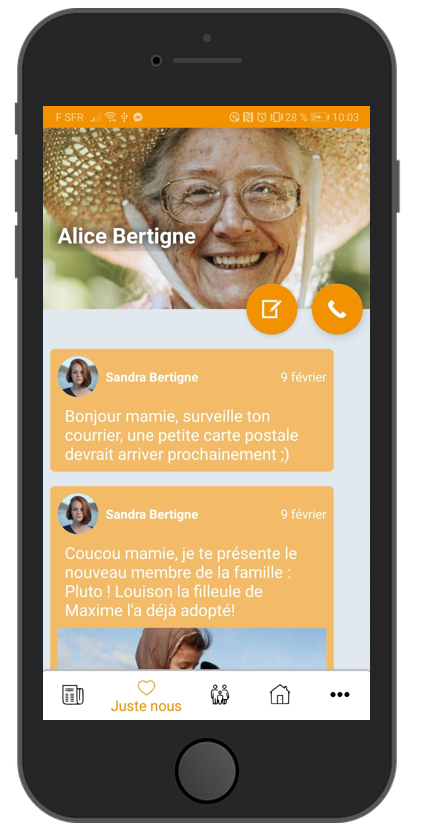
Korian Family is a digital services ecosystem designed to strengthen ties between residents and their families. Communication between residents and their loved ones is fostered by producing personalised newsletters and providing video calls via a TV or an Alexa-enabled device. Our solutions showcase living in our facilities via multi-channel publishing, and facilitate access to information and services. Greater communication between all stakeholders helps to build trust.
Smart building
Several heating system control solutions are being tested and deployed across the European building stock to improve the Group’s carbon footprint and enhance comfort. The meters will be connected to a dedicated network to monitor consumption and in the future, respond to all applications of the Internet of Things.
Connected indoor air quality sensors have been deployed throughout the portfolio in Europe. They record the CO2, temperature and humidity levels and alert staff if the established thresholds are exceeded.
In-room home automation
It allows patients and residents to remotely control lights and shutters using Alexa voice commands. In the same way, they can consult the menu of the day and the activities planned for the day. Building temperatures and indoor air quality are monitored remotely to ensure comfort and issue an alert if temperature or CO2 thresholds are exceeded.
Fall detection and prevention
The Kaspard image-free fall detection system prevents falls, which are a major cause of accelerated dependency. This technology, which is non-intrusive because it does not display an image, reconstructs the configuration of a room in the form of a point cloud, and alerts caregivers in the event of a fall or if the resident concerned has been out of their bed for an abnormally long time, which may indicate a possible fall. By the end of 2023, 15% of French facilities and 25% of Belgian sites were equipped with the system, with benefits observed in terms of caregiver satisfaction and the reduction in the number of falls in facilities.
In Germany, the Lindera fall prevention application is used by more than 80% of the network.