
Sarcopenia: a knee-lift test to improve screening accuracy
To mark the 4th Clariane/Université Paris Cité Scientific Day, held on 6 October 2026, two professionals from the Inicea Les Flots clinic in Talence presented the results of a study assessing the value of a one-minute knee-lift test to better target sarcopenia screening in older people.
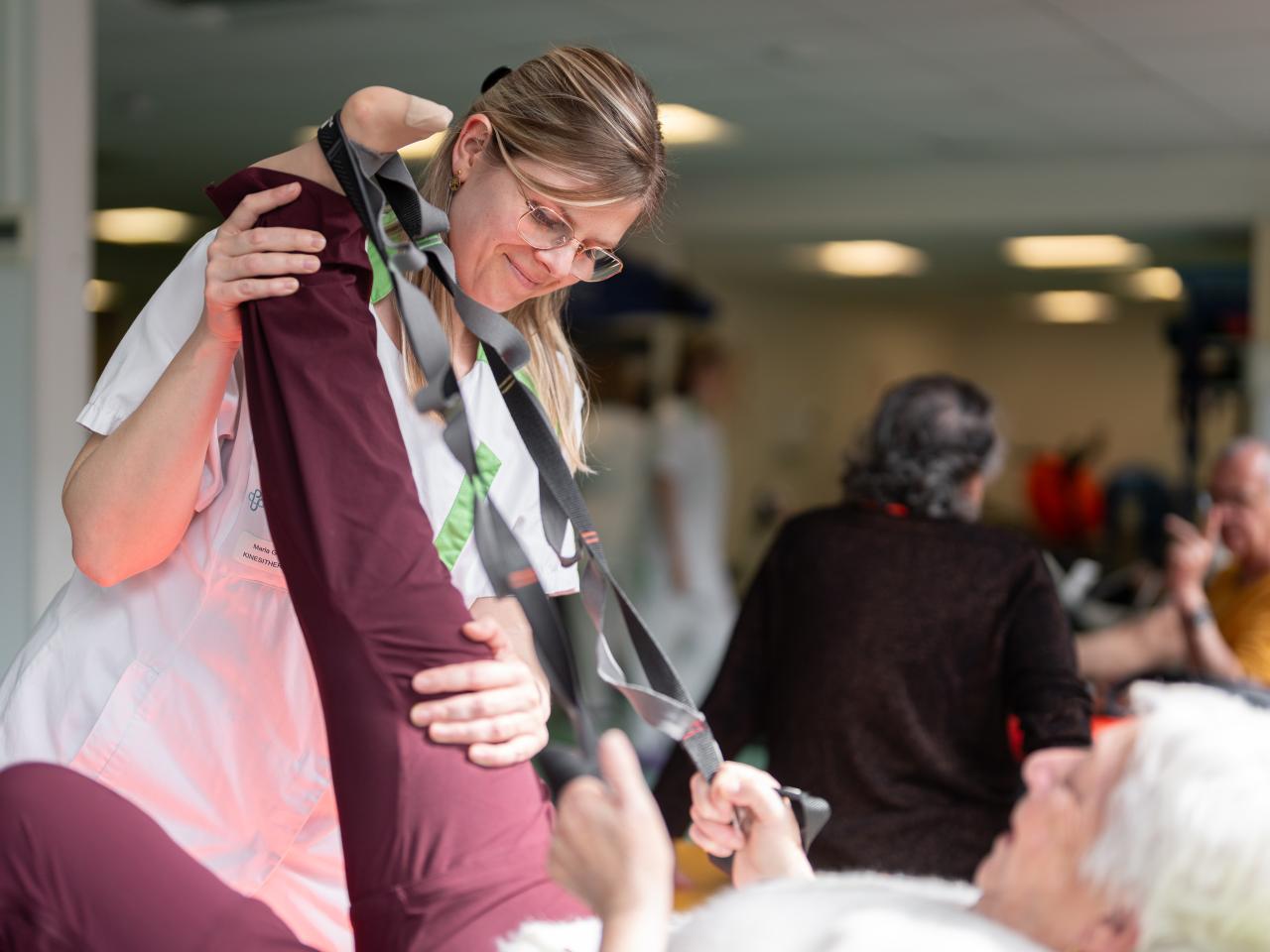
Exploring an alternative to standard functional tests
Sarcopenia is a common condition among older people, associated with an increased risk of complications and mortality. Diagnosis is based in particular on an assessment of muscle strength and functional performance, as well as on additional tests to assess muscle mass.
In clinical practice, however, certain limitations may complicate this assessment. The ‘five chair stands’ test, which is used to assess functional ability, can be affected, in particular, by balance disorders or musculoskeletal conditions. Furthermore, the use of impedance measurement – a technique used, amongst other things, to estimate muscle mass – remains difficult to implement systematically due to time and organisational constraints.
In this context, Denis Arpillière, a rehabilitation specialist, and Dr Marine Medina-Forcade, a geriatrician at the Inicea Les Flots clinic, investigated the value of an alternative test involving performing knee lifts for one minute (an adaptation of a validated test: the two-minute step test [1]).
Preliminary results that remain to be confirmed
This retrospective study examined the medical records of 63 geriatric patients, comprising 47 women and 16 men, with an average age of between 82 and 83 years, depending on gender.
The authors analysed the results of the one-minute knee-lift test, grip strength measured using a dynamometer, and the patients’ functional performance.
The analysis highlights a moderate correlation between the number of knee lifts performed and grip strength. It also suggests that a score of fewer than 25 repetitions in one minute could help to identify patients whose time taken to complete the five-chair stand test exceeds 15 seconds, the threshold set out in the European guidelines (European Working Group on Sarcopenia in Older People [2]).
When combined with a grip strength below the recommended diagnostic thresholds, this test could therefore help to better identify patients requiring further assessment using impedance measurement.
An approach worth exploring further for sarcopenia screening
While these results suggest that the knee-lift test may be a viable alternative to the five-chair-stands test, they remain preliminary.
However, the threshold of 25 repetitions will need to be verified using a larger sample. Further assessments using impedance measurement will also be required to confirm the value of this approach in targeted screening for sarcopenia.
Presented at the Clariane/Université Paris Cité Scientific Day, this research demonstrates the Group’s professionals’ commitment to evaluating new approaches aimed at better identifying patients at risk of sarcopenia.
Key takeaways
• Sarcopenia is a common condition amongst older people, and assessing it can be complicated by certain functional limitations.
• A study involving 63 patients suggests that the one-minute knee-lift test, combined with a grip strength measurement, could help to better identify patients requiring further assessment.
• The exploratory threshold of 25 repetitions in one minute will need to be verified using a larger sample. The value of this approach will also need to be confirmed by further assessments, in particular by impedance measurement.