
Rencontres FHP 2026: report on Sophie Boissard’s talk at the round table on “Who will take care of us tomorrow?”
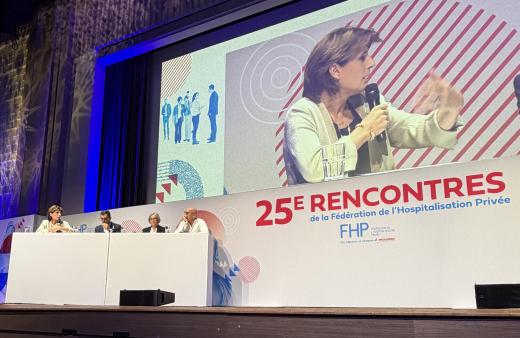
On 8 October 2026, Sophie Boissard, CEO of Clariane, participated in Rencontres FHP, organised in Paris by the Federation of Private Hospitalisation to discuss the topic of “Health 2027: the duty to act”. During a round table devoted to the future of the healthcare professions, she championed the use of multiple approaches to meet growing care needs: investing in training, promoting professional development and using technological innovation to benefit teams.
In the run-up to the 2027 French presidential election, the latest edition of the Rencontres FHP brought together political leaders, healthcare professionals and private hospitalisation stakeholders to discuss the major challenges facing the French healthcare system and the transformations that are needed.
Sophie Boissard spoke at the round table “Who will take care of us tomorrow?” alongside Alain Desbouchages, president of the Conseil national de l’Ordre des infirmiers (National Council of the Order of Nurses), Jérôme Marty, general practitioner and president of the Union française pour une médecine libre (French Union for Free Medicine – UFML), and Annie Vidal, a French member of parliament.
Train more professionals to anticipate needs
Against a backdrop of increasing strain on human resources in health, Sophie Boissard advocated for increased investment in training, particularly in the paramedical professions, with the goal of doubling the number of professionals trained each year.
To better anticipate needs, she also proposed creating a sector-based committee that would allow its stakeholders to better coordinate their efforts and adapt training capacities to the needs identified in each area.
Our chief resource, our chief value, is our professionals.
Artificial intelligence – a tool to free up time for teams
From analysing pricing data to developing smart schedules and automating certain administrative tasks, artificial intelligence opens up new opportunities to improve the way healthcare facilities work.
Many of these applications have already been implemented or are being developed within Clariane, in particular in the Inicea network’s medical and rehabilitation care clinics and mental health facilities. Their goal is to simplify processes, reduce the administrative burden on professionals and allow them to spend more time with patients.
Rolling out these innovations on a larger scale, however, requires enhanced cooperation between institutions, software publishers and public bodies to facilitate data exchange and process automation.
Focusing on career paths to make professions more appealing
Ensuring the appeal of the healthcare professions also requires opportunities for career-long progression and skills development.
At Clariane, this ambition is reflected in its development of diploma and certification courses, with the goal of enabling at least 10% of employees to embark on a course leading to a qualification.
The programmes include the Executive Master’s degree in managing healthcare companies and organisations, offered by the Clariane University in partnership with INSEEC. This Master’s-level course, accessible remotely over 14 months, allows professionals to prepare for management roles while continuing to work.
Training, innovation and career development prospects are all tools that, combined with better anticipation of human resource needs, will help prepare tomorrow’s healthcare system.