Pflege 2030 in Karlsfeld (Germany): a blueprint for the care facility of the future, now being deployed across the Korian Germany network
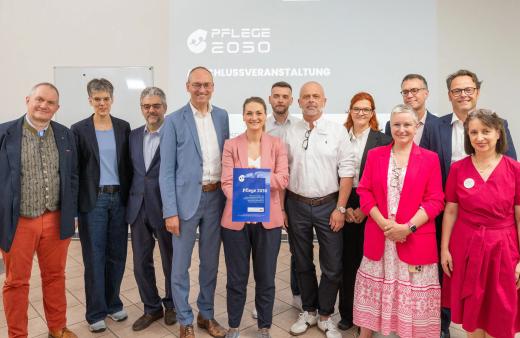
Care is facing a structural transformation — beyond a simple phase of optimisation. It was with this conviction that Korian Germany launched the Pflege 2030 model project three and a half years ago. Innovation is one of the core commitments enshrined in the mission-driven ambitions of the Clariane Group, of which Korian Germany is part. Karlsfeld has been, over these past years, the place where new technologies applied to our sector were tested under real conditions, within a fully operational facility caring for 156 residents. The project was funded with €3.1 million by the Bavarian State Ministry for Health, Care and Prevention, and scientifically supported by the University of Bremen and the Fraunhofer Institute for Integrated Circuits IIS.
Pflege 2030 is the best example of what is possible when a provider is willing to do more than what is necessary. Our thanks go to the Bavarian State Ministry for Health, Care and Prevention, which has supported this project from the very beginning, as well as to the Korian Foundation, the University of Bremen, Fraunhofer IIS, and the team on site in Karlsfeld — together, something has been created here that has significance well beyond Germany.
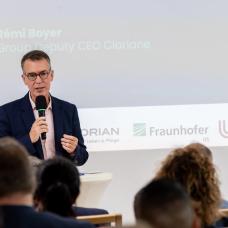
We didn't want to show what is theoretically possible, but what truly holds up in everyday practice. That's exactly why Pflege 2030 is not a completed project for us, but the starting point for scaling across the entire network.
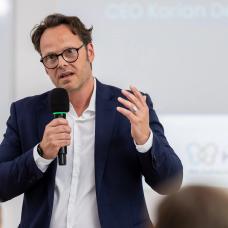
With the conclusion of the project, one thing is clear: the insights gained in Karlsfeld are already being integrated, step by step, into the entire German network of facilities.
Concrete results from four years of real-world testing
The project's greatest benefit is not a list of technologies — it is the certainty of what works, what does not, and why. Among the standout results is voice-assisted care documentation: it saves each caregiver approximately 30 minutes per day, while simultaneously improving documentation quality — a measured result, not an estimate, and one of the most significant efficiency gains in care practice in recent years.
AI-supported fall detection uses sensor technology to track residents' movements in their rooms, enhancing their safety and autonomy without disrupting their daily lives. Cleaning robots automate routine floor-cleaning tasks, freeing up time for staff. Digital tools for daily scheduling and activity support help structure residents' days while easing the organisational burden on care teams.
Some technologies did not prove their worth in practice — including a mobility analysis app, an ECG toilet seat, automatic repositioning beds and smartwatches. The fit between real-world use and team acceptance matters more than technology alone. A clear "not yet" is the responsible outcome of rigorous testing.
Key learnings: technology and work organisation
Nearly four years of hands-on experimentation yield two structural conclusions. On the technology side, the project has confirmed that infrastructure quality and interoperability are non-negotiable prerequisites: digital solutions only realise their full potential when they communicate seamlessly with one another and with existing systems, and when staff play an active role in their selection and are trained to use them. The guiding principle is simple: technology supports care — it does not replace it.
On the organisational side, Pflege 2030 has validated the KubA model (Kompetenz- und Bewohnerorientierte Arbeitsorganisation — competency- and resident-oriented work organisation), an approach in which care process, primary nursing, work organisation and staff competencies are developed together rather than separately. Introducing KubA is possible with any team composition; what determines lasting success is the targeted development of care assistants, sustained management commitment and continuous investment in staff development. A change of this depth is not a one-off project, but a multi-year process.
From pilot project to rollout — next steps
AI-supported fall detection is already available today as a bookable additional service in all Korian facilities, and cleaning robots are being progressively deployed at further locations. In the fourth quarter of 2026, a new central care management system — integrating care documentation, billing, and shift and route planning — will launch at eight pilot locations in Germany, forming the foundation for the company's long-term digital development; the network-wide rollout begins in the first half of 2027. Voice-assisted care documentation will be progressively deployed across the entire network from 2027.
By 2028, Korian will have transferred all solutions validated in Karlsfeld to its entire German network — four years of hands-on experimentation will thus benefit residents and care teams throughout Germany.
What has been built in Karlsfeld carries significance well beyond Germany. The learnings from Pflege 2030 — on digital infrastructure, on work organisation, on what has genuinely proven itself in care practice — will shape Clariane's innovation strategy across all six countries. Germany, and Karlsfeld in particular, has become a reference point for the care facility of the future at European scale.
Find all Pflege 2030 resources here: