
What if the care facility of the future already existed?
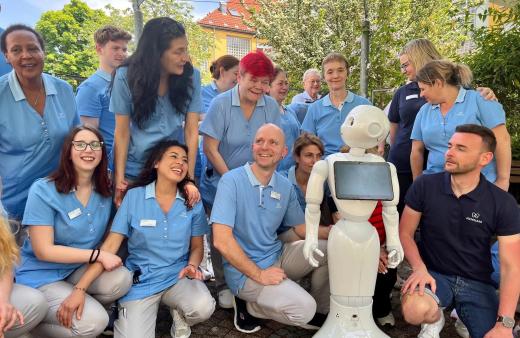
In Karlsfeld, near Munich, Korian has just concluded three and a half years of real-world experimentation. The goal: to test, in a fully operational facility, what technology can concretely bring to the daily lives of residents and care teams.
A public-private bet on the future of care
Funded to the tune of €3.1 million by the Bavarian State Ministry for Health, Care and Prevention, Pflege 2030 was built as a partnership between Korian Allemagne, the University of Bremen and the Fraunhofer Institute IIS. Together, they made the choice to test at full scale — in a live facility with 156 residents — what technology can genuinely contribute to the everyday reality of care.
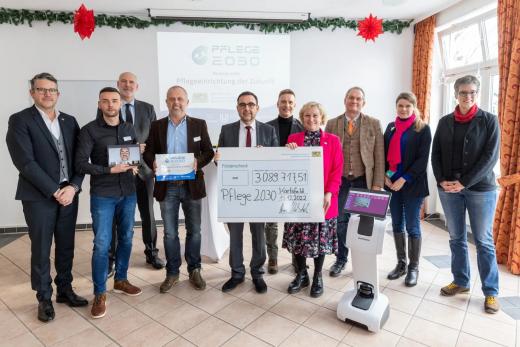
Three and a half years of experimentation, concrete results
For three and a half years, in the bedrooms, corridors and care rooms, everything was tested. Not in theory. In practice. And the results are there — measured, documented, published.
Voice-assisted care documentation saves approximately thirty minutes per caregiver per day — thirty minutes given back not to paperwork, but to residents. Intelligent sensors detect falls discreetly, without turning the facility into a surveillance environment. Robots handle floor-cleaning, freeing care teams for what no machine can do: presence, listening, the care of human connection. Digital tools help structure residents’ days, preserve their autonomy, and sustain what makes a life worth living.
Some technologies did not survive the test of reality — an ECG toilet seat, an automatic repositioning bed, a fall-analysis app. The project says so plainly, without evasion. That honesty is part of the method: you learn nothing from what you don’t test, and you don’t move forward by concealing what doesn’t yet work.
Technology at the service of people
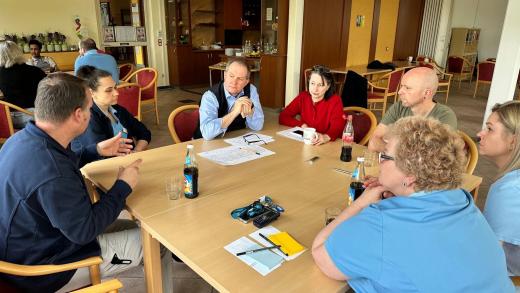
Behind each of these innovations lies a conviction that shapes Clariane’s entire approach: technology only has value if it serves people — those who are cared for, and those who care. In Karlsfeld, no solution was deployed without the genuine involvement of care teams in its selection, without training, without continuous evaluation of its real impact on daily practice. The question was never "what is technically possible?" but “what truly makes the work more human?”
From Karlsfeld to Europe
The validated solutions are now entering the network: AI-supported fall detection is already available in all Korian facilities in Germany, cleaning robots are being progressively deployed, and voice documentation will be rolled out across the entire network from 2027. By 2028, the whole German network will benefit from four years of rigorous, real-world testing. And beyond Germany, the lessons from Karlsfeld are now feeding into Clariane’s thinking across all six of its European countries.
What was built here will not stay here.