
Cerebrovascular accidents: an issue of prevention and awareness
Summary:
On the occasion of World Stroke Day on October 29th, the Korian Group reminds us of the importance of being informed and aware in order to better spot the signs and help the victims of a stroke. Rapid treatment is necessary to limit the impact of a stroke on health and the development of after-effects. In this context, several Inicea clinics (Inicea: the brand name for the Group's health activities) are conducting awareness campaigns.
A stroke: what is it?
A stroke occurs when blood flow to or within the brain is interrupted by a blocked blood vessel (most commonly an ischaemic stroke) or by a ruptured blood vessel (haemorrhagic stroke), in less than 15% of cases. (Source: Ministry of Health and Prevention)
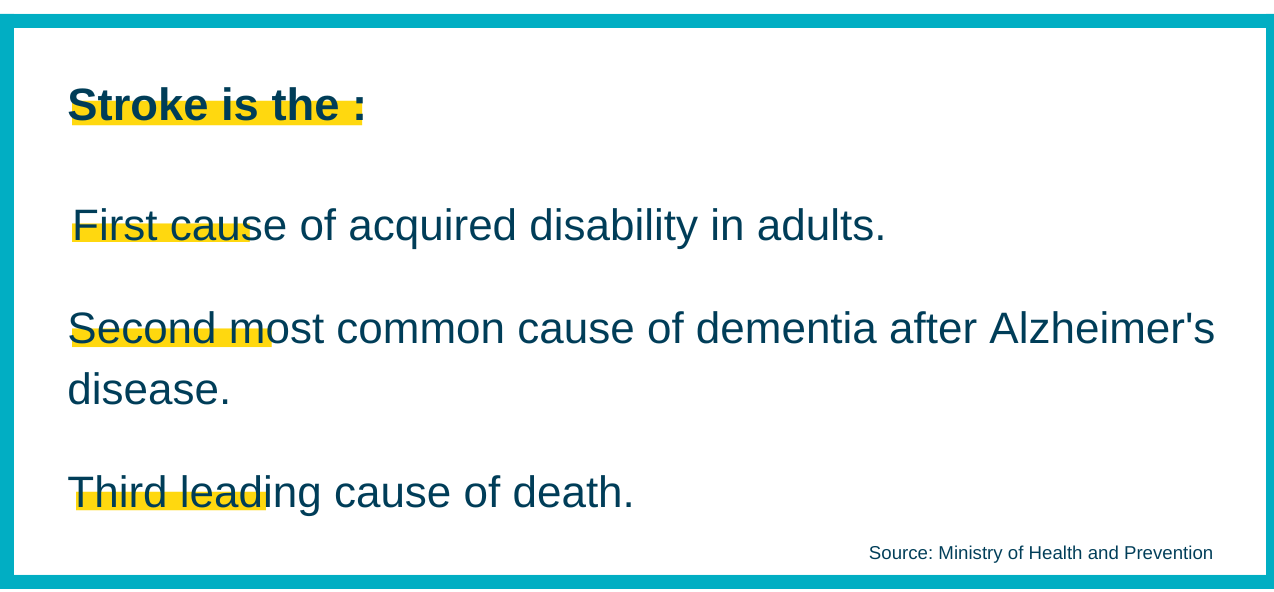
With 120,000 to 140,000 new strokes occurring each year in France alone, neurovascular diseases are a public health priority. Across Europe, a new stroke occurs every 1 to 4 minutes.
How can stroke be prevented?
Certain lifestyle habits are risk factors and are associated with 90% of strokes. To reduce the risk of high blood pressure, obesity, diabetes and high cholesterol, which can all contribute to stroke, we can all adopt these few habits:
- Eat a balanced diet,
- Stop smoking,
- Reduce alcohol consumption,
- Engage in regular physical activity.
How to detect a stroke?
Know the main warning signs:
- Mouth drooping (an uneven smile or facial asymmetry)
- Weakness on one side of the body, arm and/or leg (one arm cannot be raised or drops)
- Speech difficulties (difficulty speaking or understanding)
At the slightest sign or suspicion, call the emergency services immediately.
Stroke management at Korian
In France
In France, the stroke care pathway is well established, with patients admitted to a neurovascular unit to receive specialised care, including clinical assessment, imaging and procedures such as thrombectomy or thrombolysis. Following a stroke, patients may be referred, depending on the severity of their disability, to a facility providing specialised medical and rehabilitation care. While many Inicea clinics receive these patients, 12 are specifically dedicated to stroke care and hold the “specialised in neurological conditions” designation.
They provide a full range of conventional rehabilitation therapies, including physiotherapy, occupational therapy, adapted physical activity, speech therapy, neuropsychology and social support, as well as more advanced technologies, such as rehabilitation robots, exoskeletons and rTMS. Care is delivered within a medical environment focused on reducing cardiovascular risk factors, including smoking, hypertension, dyslipidaemia, diabetes and sedentary lifestyles. Teams also implement secondary prevention strategies to reduce the risk of recurrent stroke and manage complications related to central nervous system damage, including spasticity and neuro-orthopaedic disorders, through botulinum toxin injections, multidisciplinary programmes and specialised expertise. The primary objective is to help patients regain the highest possible level of independence, with or without adaptations.
In 2021, 2,100 admissions, representing 102,693 patient days, were recorded in Inicea medical care facilities in France for post-stroke rehabilitation.
The Marienia rehabilitation clinic (Cambo-les-Bains) has developed a digital post-stroke care pathway to support patients from the onset of stroke, throughout rehabilitation and after returning home. The programme relies on a platform developed by the start-up Move In Med, which connects hospital teams, community healthcare professionals and the patient. A dedicated care coordinator regularly sends follow-up questionnaires and secondary prevention guidance to help reduce risk factors. A specialised mobile team also remains available to assess patients and provide support at home.
Rééduc’adom at Les Cyprès clinic (Avignon)
Mainly dedicated to post-stroke patients, this pilot programme provides rehabilitation expertise, care and follow-up directly in the patient’s home over a one-year period through structured coordination between hospital teams and primary care professionals.
The originality of the Rééduc’adom pathway lies in its fully integrated approach, with rehabilitation taking place in the patient’s own living environment. Coordination is supported by a dedicated digital platform and mobile application, helping ensure optimal treatment adherence and follow-up.
As part of its rehabilitation programme, the Les Cyprès clinic also offers assessment and support for returning to driving, notably through the use of a driving simulator. Since neurological impairments may affect driving abilities, resuming driving requires a comprehensive evaluation of each patient’s deficits as well as their compensatory abilities.
In Spain
The Torre del Mar senior residence has recently opened a specialised neurorehabilitation unit designed to improve the functional abilities and quality of life of people living with brain injuries. The unit has 28 inpatient beds and also treats outpatients.
In addition, many post-stroke patients are admitted directly to nursing homes across all countries, particularly when they are older or have limited rehabilitation potential.
In Spain, more than 435,400 people are living with brain injuries, nearly two-thirds of whom are over the age of 65. (Source: Spanish National Statistics Institute – INE.)
In Italy
Nine clinics provide care for post-stroke patients.